


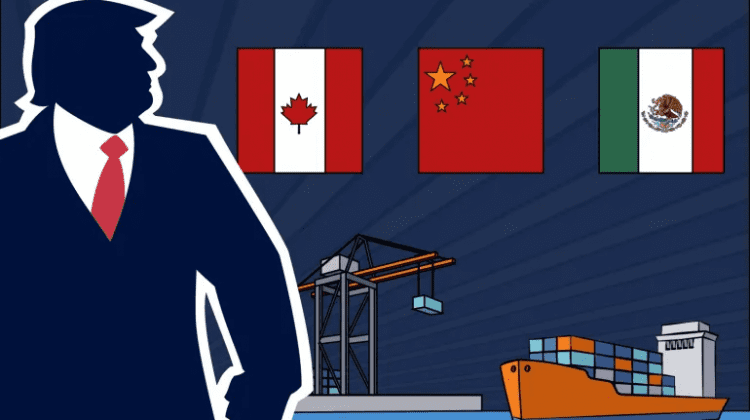
The Trade War : Strategic Choices Amid the Power Game
I. Background
On February 1 (local time), the U.S. government issued a rare statement naming Mexico, Canada, and China simultaneously, accusing the three countries of “inadequate supervision” in combating drug trafficking and transnational money laundering. The statement claimed that the U.S. would adopt strong economic and diplomatic measures to pressure these nations to strengthen border control and chemical management.

According to the document, the Mexican government was accused of having “inappropriate connections” with drug cartels and of tolerating the production and transportation networks responsible for hundreds of thousands of overdose deaths in the U.S. in recent years.
Canada was alleged to have contributed to the expansion of international drug networks through the sharp increase of fentanyl synthesis laboratories within its territory.
Meanwhile, China was blamed for “regulatory loopholes” in chemical supervision, ineffective monitoring of fentanyl precursor exports, and “insufficient efforts” in combating cross-border money laundering.
The U.S. government stated that these issues have collectively formed a “systemic national security threat” and must be met with strong countermeasures.
II. Countermeasures by Each Country

According to the latest reports on February 2 (local time), Canadian Prime Minister Justin Trudeau announced retaliatory tariffs on U.S. goods worth CAD 155 billion (approximately USD 107 billion), covering key sectors such as energy, machinery, automobiles, and food. Among these, tariffs worth CAD 30 billion would take effect immediately, while the remaining tariffs would be implemented within 21 days.
Meanwhile, the President of Mexico announced on social platform X that he had demanded President Trump agree to cooperate by February 2 (local time), otherwise “Mexico will take retaliatory measures.” He further instructed the Minister of Economy to execute the previously developed “Plan B,” which includes both tariff and non-tariff measures to defend Mexico’s national interests.
In response to the U.S. tariff order, China issued a clear statement condemning the unilateral imposition of tariffs as a severe violation of World Trade Organization (WTO) rules, arguing that such measures would neither solve U.S. domestic issues nor benefit normal trade cooperation. China announced it would file a complaint with the WTO and implement corresponding countermeasures to firmly defend its legitimate rights and interests.
A spokesperson from China’s Ministry of Public Security expressed strong dissatisfaction and firm opposition to the U.S. decision to impose tariffs under the pretext of fentanyl-related concerns. The spokesperson emphasized that “China has no large-scale domestic abuse of fentanyl. Out of humanitarian concern, at the request of the U.S., China was the first country in the world to place the entire class of fentanyl-related substances under control in 2019. Since then, China has not received any notification from the U.S. about seizures of such substances originating from China.”
III. Temporary Truce and Ongoing Negotiations

On the afternoon of February 3 (local time), the U.S., Canada, and Mexico reached a consensus to delay the implementation of tariffs for 30 days. Meanwhile, The New York Times reported that President Trump was expected to hold a phone conversation with Chinese officials regarding the tariff issue on the same day, though the exact time remained undisclosed.
On February 4, China’s Customs Tariff Commission of the State Council issued an announcement stating that, starting from February 10, additional tariffs would be imposed on certain imports from the U.S. Specific measures include:
● a 15% tariff on coal and liquefied natural gas (LNG),
● a 10% tariff on crude oil, agricultural machinery, large-displacement vehicles, and pickup trucks.
IV. Strategic Choices for Overseas Expansion: Risk Mitigation, Diversification, and Localization
In this dual political and economic power game, strategic adjustments by enterprises are especially crucial.
- Elite Stage Consulting Recommendation: Diversify to Mitigate Risk
Prioritize multi-location manufacturing strategies in Canada, Mexico, Southeast Asia, and other regions to build a resilient supply chain. Strengthen local compliance capabilities.
- Establish independent legal or tax entities in the U.S. and Canada, and proactively assess tariff exposure, tax treaty implications, and transfer pricing risks. Maintain dynamic responses to policy changes.
- Build a coordinated network with local law firms and accounting firms to monitor trade and regulatory developments in real time.
Focus on Long-Term Trends
While the fentanyl issue appears to be primarily a drug control matter, it fundamentally reflects the U.S.’s logic of reasserting control over supply chains and technology security. Enterprises need to rethink “compliance” and “market access” from a geopolitical perspective.
Opportunities Amid Intensified Power Games
When tariffs are used as instruments of geopolitics, the restructuring of global supply chains becomes inevitable.
For Chinese enterprises, challenges and opportunities coexist — those who can succeed through compliance, localization, and innovative thinking will secure a foothold in the new global landscape.
Elite Stage Consulting helps enterprises navigate uncertainty and confidently embark on the North American market.