



Asia Residency Renewal Crisis 2026: The Dangerous Fiscal Trap Between Holding a Visa and Being a Tax Resident
It is June 2026, and the “easy visa” era in Asia has officially ended. For foreign business owners and investors who rushed to secure Hong Kong’s Top Talent Pass Scheme (TTPS) or Singapore’s Employment Pass(EP) during the 2023-2024 rush, the bill has come due.
The current anxiety among foreign HNWIs is palpable. It is no longer about getting the visa; it is about renewing it. In 2026, Immigration departments in both Hong Kong and Singapore have synced their databases with their respective tax authorities (HKIRD and IRAS) to a degree unprecedented in pre-BEPS times. Foreigners who used these visas purely as travel documents or contingency plans—without establishing real fiscal footprints—are finding their renewal applications scrutinized, delayed, or outright rejected, leaving their regional assets and families in limbo.
【Deep Policy Disassembly】
The 2026 Nexus: Immigration Compliance is now Tax Compliance
Historically, visa maintenance (Immigration) and tax residency (Fiscal) were managed separately. In 2026, this separation is a dangerous illusion for two reasons:
● Hong Kong’s TTPS & Quality Migrant Audit: The TTPS, which granted easy entry to high earners/graduates around 2023, now requires strict proof of “ordinary residence” and local employment/business establishment for renewal in 2026. HK Immigration is actively auditing physical presence. If you claimed tax benefits as a non-resident while holding a HK permanent residence-track visa, you have created a direct contradiction.

● Singapore’s COMPASS Framework & Salary Audit: Singapore’s COMPASS (Complementarity Assessment Framework), which became operational around 2023, is now fully mature. Renewing an EP in 2026 requires proving the salary paid is genuine, market-competitive, and backed by actual business operations. IRAS is aggressively identifying “salary recycling”—where foreigners pay themselves a high salary solely to secure a visa, without the company having real economic substance.
Furthermore, with BEPS 2.0 now fully operational globally, AEOI (Automatic Exchange of Information) mechanisms in 2026 are hyper-efficient. If you claim to be a Singapore resident to avoid tax in your home country, IRAS expects to see you paying Singapore tax on your global income (where applicable) and spending significant time there.
【Practical Advice / Avoid Pitfalls】
Your 2026 Residency Survival Guide: Establishing the ‘Vital Ties’ Standard
Foreign owners must shift from managing a “visa process” to managing a “global tax footprint.”
What You MUST DO Now (Steps):
1. Immaculate Physical Presence Log: Maintain a precise, auditable log of every entry and exit from your claimed residency jurisdiction. In 2026, you generally need to target 183+ days in-country to secure tax residency, and at least significant, consistent presence to secure a visa renewal.
2. Validate Your Salary: Ensure that any salary you receive from your Singapore or Hong Kong entity is justified by your role, supported by company revenue (substance), and matches market rates. If your business is pre-revenue, ensure it is funded by clear capital injections.
3. Demonstrate ‘Vital Ties’: Beyond days spent, you must establish local economic and social ties. This includes maintaining a dedicated residential lease (not a hotel), local utility bills, a local bank account, and, if applicable, club memberships or family enrollment in local schools.

What You MUST STOP Doing (Pitfalls):
● Don’t: Maintain a “nominee employment” relationship just to get a visa. In 2026, both HK and Singapore authorities will cross-check the entity’s contributions to local social security (MPF in HK, CPF in SG) and tax revenues.
● Don’t: Claim to be a non-resident for tax purposes in the same jurisdiction where you have applied for a permanent residency-track visa. This is a red flag.
● Don’t: Rely purely on a “remote work” justification for renewal unless your role genuinely has no local economic impact. Authorities in 2026 are looking for local value creation.
【Practical Advice / Avoid Pitfalls】
The 2026 Asian Residency Landscape: Immigration vs. Tax Reality
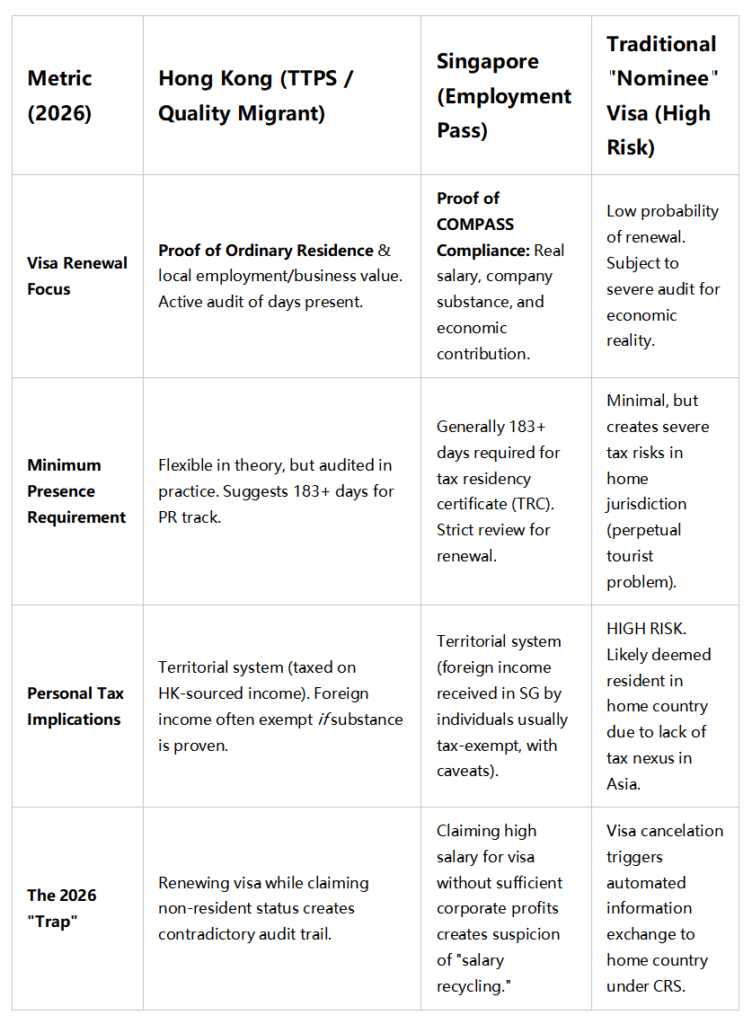
In the fiscal environment of June 2026, a visa is just a travel document; tax residency is the fiscal fingerprint that determines your global financial security. Foreign business owners must stop treating residency planning as a bureaucratic exercise and start treating it as a core component of their wealth management. If your physical presence does not match your claimed fiscal identity, the systems of 2026 will find the contradiction.