



Accounts Closed: The 2026 Singapore Reality Check Is Your Corporate Service Truly Reliable?
“My corporate account was perfectly fine yesterday; today, the bank suddenly notified me it will be closed within 30 days. Why?”
“I’ve tried three different banks, and every account application was rejected. Does Singapore no longer welcome Chinese enterprises?”
In 2026, these are the cries of despair our tax and compliance team hears almost daily. Once the undisputed “premier safe harbor in Asia” in the eyes of outbound enterprises, Singapore remains prosperous, but the barrier to entry has risen to staggering heights. This year, Singapore’s Anti-Money Laundering (AML) regulation has reached its zenith, causing the threshold for both account opening and maintenance to skyrocket. The resulting ripple effect—mass account closures and rejected filings—defines the true reality of operating a Singapore company in 2026.
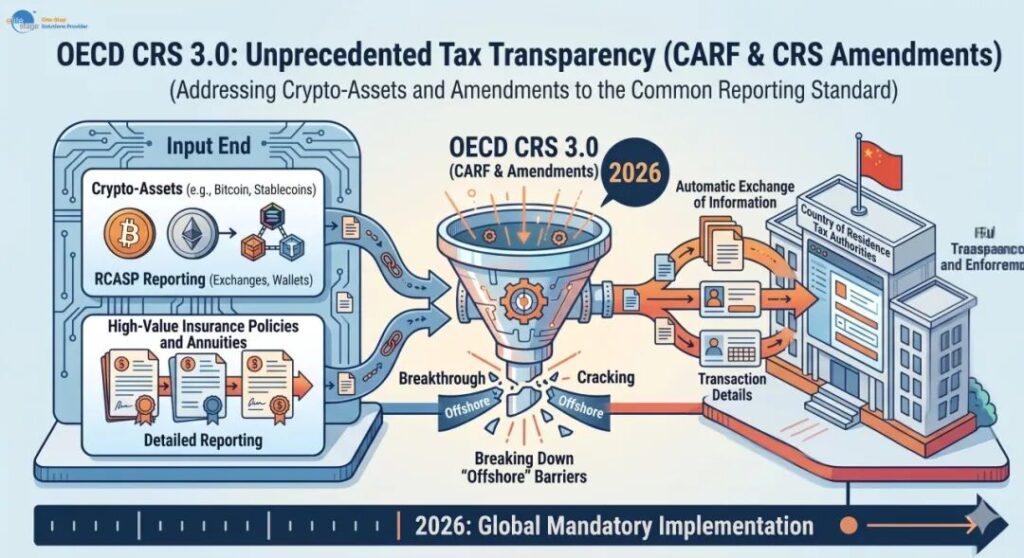
Many business owners mistakenly believe that after registering a Singapore company and obtaining a bank token, they can rest easy. They are unaware that they are walking on the edge of a “dual purge” by both the Monetary Authority of Singapore (MAS) and the Accounting and Corporate Regulatory Authority (ACRA).
Singapore Corporate Compliance Landscape (2024 vs. 2026)
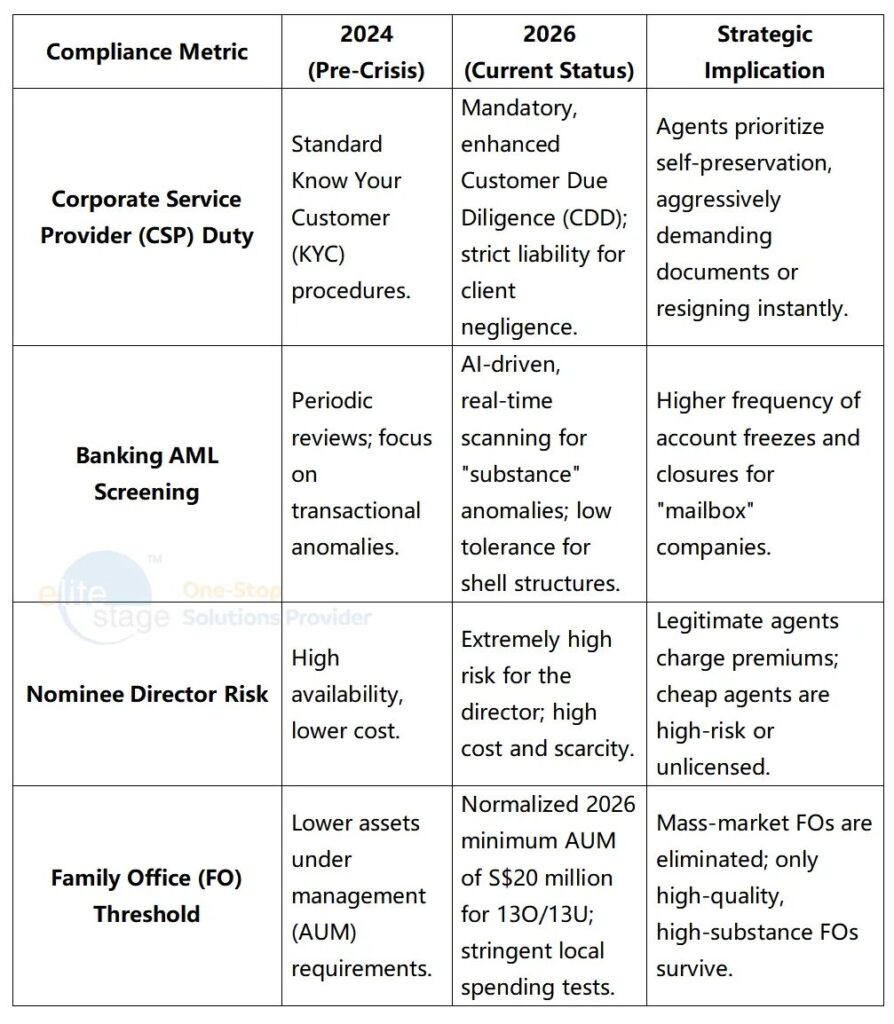
In-Depth Policy Analysis: The Total Shift from “Easy Entry” to “Strict Oversight”
The core causes of the 2026 compliance earthquake in Singapore lie in the comprehensive tightening of two regulatory mechanisms:
1. The Full Implementation of the Corporate Service Providers Act
The Corporate Service Providers (CSP) Act has revealed its full bite in 2026. To combat money laundering and shell companies, Singapore is not only scrutinizing enterprises but also rigorously penalizing agents—the “kill a chicken to scare the monkeys” approach.
● Key Regulatory Requirement: All registered CSPs must perform extremely rigorous Customer Due Diligence (CDD). If a CSP assists a client in concealing ultimate beneficial owners (UBOs) or turns a blind eye to abnormal fund movements, the CSP faces fines of up to S$100,000, and its senior management may face imprisonment.
● The Ripple Effect: This has directly led to a massive shake-up among Singapore’s corporate secretarial firms. To protect themselves, your agent will frantically demand business proof documents (e.g., contracts, invoices, shipping documents). If you cannot provide them, they will unilaterally terminate their nominee director services, leaving your company instantly in violation of the Companies Act.
2. The Inaccessibility of Family Offices
The days of setting up a Family Office with a few million Singapore dollars to obtain an Employment Pass (EP) are officially over. In 2026, the threshold for Singapore Family Offices (VCC/13O/13U structure) has stabilized at a minimum entry cost of S$20 million. Furthermore, ACRA and MAS now perform extremely strict audits on the number of local employees and Local Business Spending requirements.
【Case Study: Paralysis Due to an “Inactive Agent”】
Background:
Mr. Li is the owner of a domestic 3C digital cross-border e-commerce business. In 2024, to expand into Southeast Asia and launch operations on TikTok, he registered a Singapore company and opened a local business bank account through a low-cost intermediary. Due to a lack of genuine international operational experience, Mr. Li’s company had no physical office in Singapore and hired no local employees; all payment flows were merely accounting entries moving through the account.
The Fallout:
In mid-2026, Mr. Li’s low-cost secretarial firm had its license revoked by ACRA due to severe violations discovered during an anti-money laundering spot check. Upon the firm’s collapse, Mr. Li’s Singapore company instantly lost its compliant nominee director and registered address.
When the Singapore bank’s compliance system scanned the company’s status abnormality, it immediately triggered an Anti-Money Laundering (AML) alert. The bank not only froze nearly US$2 million in working capital within the account but also demanded Mr. Li provide complete customs declarations and logistics bills of lading for all large transactions over the past 12 months. Because Mr. Li’s document management was haphazard, he could not prove the trade authenticity of the funds. Ultimately, the account was forcefully closed. Although the funds were eventually returned via the original route after three months of appeal, his perfectly planned international expansion was severely disrupted, resulting in heavy losses.
Actionable Advice & Trap Avoidance
In 2026, when AML regulation has peaked, you must do three things to survive safely in Singapore:
1. Immediately Conduct “Due Diligence” on Your CSP: Do not select agents based solely on price. Visit the ACRA website to verify that your agent holds the required license and has no record of penalties. Low-cost agents are often high-risk agents; if they collapse, your company and bank account will be among the first casualties.
2. Construct Genuine “Economic Substance (ES)”: Singapore no longer welcomes pure “invoicing centers” or “pass-through channels.” Regardless of how small your business is, you must maintain a complete business chain of evidence: genuine trade contracts, inter-company email correspondence, and logistics/customs documentation. If your profits are substantial, it is advisable to lease a physical workspace and hire part-time or full-time employees in Singapore as soon as possible.
3. Large Fund Movements Must Be Supported by ODI Filing (for Chinese Investors): When a domestic parent company injects capital into a Singapore subsidiary, absolutely do not use grey-market channels. Diligently complete the Outbound Direct Investment (ODI) filing with the Ministry of Commerce (MOFCOM), the National Development and Reform Commission (NDRC), and the State Administration of Foreign Exchange (SAFE). This is the strongest endorsement you can provide to a Singapore bank proving that your source of funds is entirely legal and clean.
In 2026, compliance in Singapore is no longer an optional “talisman” that can be purchased; it is the “ventilator” for enterprise survival. Overseas structures devoid of economic substance are like skyscrapers built on sand; a single tsunami named “Anti-Money Laundering” will cause them to collapse instantly.